
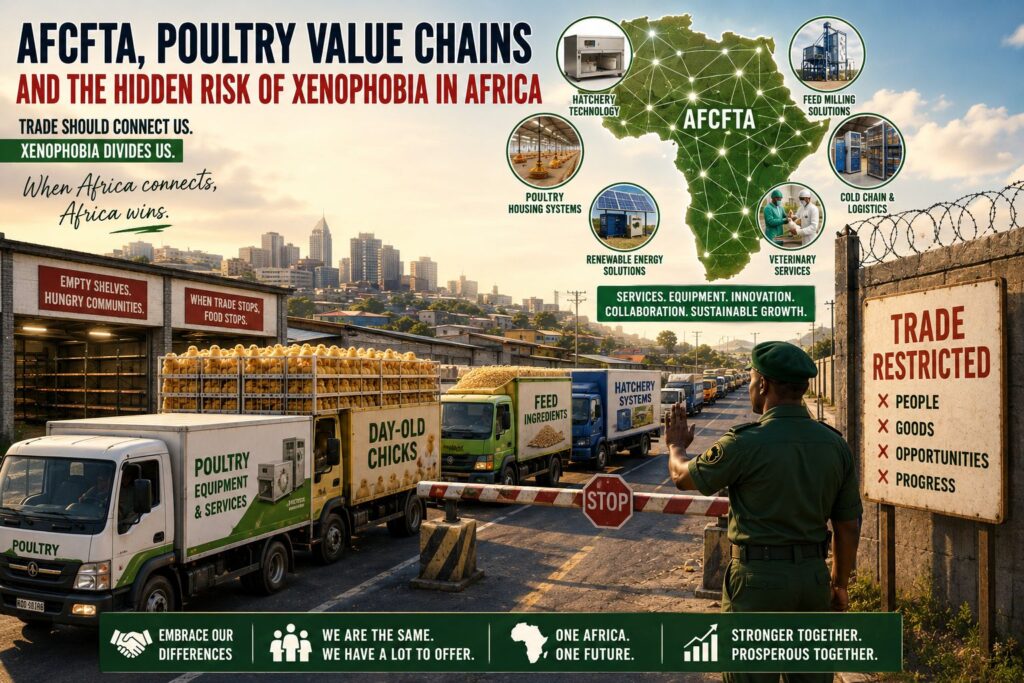
AfCFTA, Poultry Value Chains and the Hidden Risk of Xenophobia in Africa
How African Trade Integration Can Transform Poultry Services, Agribusiness and Youth Employment
By Solomon | Diary of a Farmer
Africa is entering a new era of economic integration through the African Continental Free Trade Area (AfCFTA) — a landmark agreement designed to create a single African market connecting more than 1.3 billion people across the continent.
For agriculture and agribusiness, especially the poultry value chain in Africa, this presents one of the biggest opportunities in decades.
But while Africa is pushing toward deeper regional trade and economic collaboration, recent waves of xenophobic tensions in parts of the continent are raising difficult but important questions:
Can Africa truly unlock the full potential of AfCFTA if Africans continue to shut doors against fellow Africans?
And what does this mean for the future of the poultry industry, agribusiness investment, youth employment, and sustainable food systems in Africa?
Understanding AfCFTA and Why It Matters to African Agriculture
The African Continental Free Trade Area (AfCFTA) was created to increase intra-African trade by reducing tariffs, improving movement of goods and services, and strengthening regional value chains.
For years, many African economies have relied heavily on imports from outside the continent, despite having enormous agricultural potential.
AfCFTA aims to change this by encouraging:
• Regional production systems
• Cross-border trade collaboration
• Industrial development
• Agribusiness investment
• Youth entrepreneurship
• Sustainable economic growth
For the poultry sector, this could become transformational.
The Future of the Poultry Value Chain in Africa
When many people think about poultry, they focus only on chickens or eggs.
But the modern poultry industry is far bigger than production alone.
The real opportunities under AfCFTA are increasingly found in the broader poultry value chain ecosystem, including:
• Poultry equipment manufacturing and distribution
• Hatchery systems and incubator technologies
• Feed milling infrastructure
• Cold chain logistics and storage
• Poultry housing systems
• Renewable energy solutions for farms
• Veterinary services and animal health
• Agritech and digital supply chain platforms
• Training and technical support services
This is where African countries can collaborate, scale innovation, and create sustainable jobs for millions of young people.
Why Poultry Services and Equipment Matter More Than Ever
Due to ongoing restrictions in many African countries regarding direct poultry imports such as eggs and frozen chicken, the strongest cross-border opportunities now lie within:
• Poultry infrastructure
• Technical services
• Equipment supply chains
• Knowledge transfer
• Agricultural technologies
This shift creates enormous opportunities for:
• African entrepreneurs
• Equipment suppliers
• Renewable energy providers
• Agritech startups
• Hatchery operators
• Agricultural consultants
• Logistics companies
The future of African poultry is becoming increasingly technology-driven and service-oriented.
AfCFTA and Youth Employment in Africa
Africa has one of the youngest populations in the world.
At the same time, unemployment and underemployment remain major challenges across many countries.
This is why the poultry value chain matters so much.
A stronger poultry ecosystem creates opportunities in:
• Agribusiness development
• Equipment installation and maintenance
• Feed production
• Farm management
• Processing and packaging
• Cold chain logistics
• Veterinary support
• Digital agriculture solutions
These are not just farming jobs.
They are modern agribusiness careers capable of transforming local economies and creating sustainable livelihoods for African youth.
Sustainability and the Future of African Poultry
As the poultry sector grows across Africa, sustainability must remain at the center of development.
The future of sustainable poultry farming in Africa depends on:
• Energy-efficient systems
• Climate-smart agriculture
• Waste reduction and recycling
• Solar-powered farm infrastructure
• Efficient feed management
• Sustainable water usage
• Responsible supply chain systems
African agriculture must not only grow bigger — it must also grow smarter and more resilient.
The Hidden Risk: Xenophobia and Fragmentation in Africa
Despite the opportunities presented by AfCFTA, one major challenge continues to threaten progress: xenophobia and regional fragmentation.
The recent rise in xenophobic tensions across parts of Africa is deeply disheartening.
At a time when the continent should be strengthening collaboration, regional trade, and economic integration, division only weakens African industries and slows down shared progress.
When African entrepreneurs, traders, or businesses are treated as outsiders within Africa:
• Supply chains become disrupted
• Investment confidence declines
• Knowledge sharing is reduced
• Regional partnerships become weaker
• Trade opportunities are lost
This affects more than people.
It affects food systems, agribusiness growth, and the future of African trade itself.
Why Africa Must Embrace Collaboration Over Division
The success of AfCFTA depends on more than policies and trade agreements.
It depends on mindset.
Africa cannot fully benefit from regional integration while simultaneously building barriers between Africans.
The poultry value chain is one of the clearest examples of how interconnected African economies already are.
One country may specialize in feed production.
Another may provide hatchery technology.
Another may lead in logistics or processing infrastructure.
Each part strengthens the whole ecosystem.
This is why collaboration matters.
Africa grows faster when Africans grow together.
The Future of African Agribusiness Is Connected
The future of African poultry is not just production.
It is:
• Infrastructure
• Technology
• Services
• Innovation
• Sustainability
• Regional partnerships
AfCFTA creates the opportunity for Africa to build stronger agricultural systems from within the continent itself.
But this can only happen if African countries, businesses, and communities choose cooperation over fragmentation.
Because when Africa connects, Africa wins.
About the Author
Solomon | Diary of a Farmer
Solomon is an agricultural value chain advocate and agribusiness development professional focused on poultry systems, sustainable agriculture, agricultural finance, and Africa-focused agribusiness opportunities.
Through Diary of a Farmer, he explores the future of African agriculture, food systems, agritech innovation, and regional trade opportunities under AfCFTA.